Evolution of recombination
Genetic recombination is a fundamental biological process that ensures proper chromosomal segregation during the reduction division of meiosis. During recombination, homologous chromosomes exchange genetic material through crossing-overs. These events lead to breaking the parental allelic associations and can create new combination of alleles in the offspring. This makes recombination one of the drivers of the evolution of genetic diversity in populations.
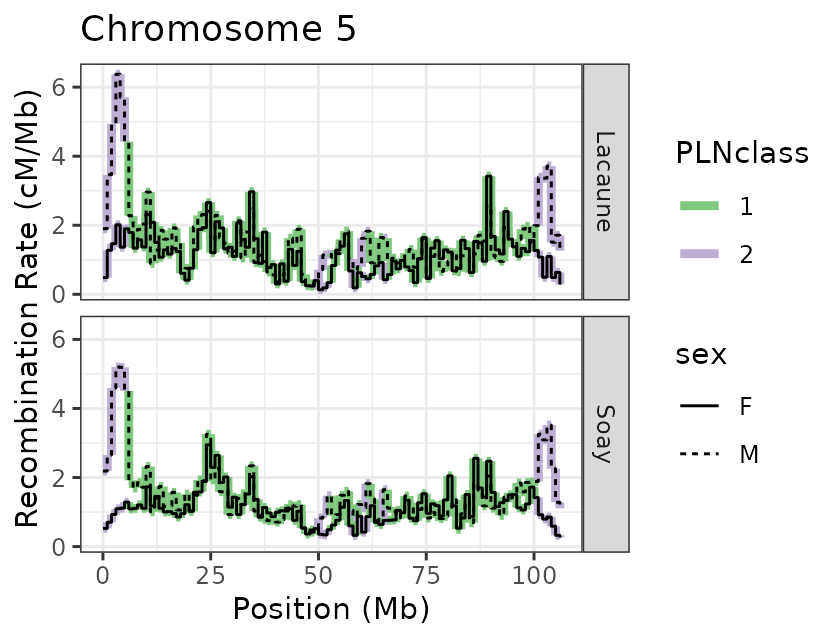
The distribution of crossing-overs in a population of gametes is not homogeneous along a chromosome : some genomic regions recombine more than others, meaning that the probability that they are involved in a crossover event is higher. This probability is measured in terms of their recombination rate wich is expressed in Morgans (expected number of crossovers) per base (unit of physicical distance along a DNA molecule) or more usually in centiMorgans (hundredth of Morgans) per megabase (millions of base pairs). Knowing the distribution of recombination rates along the genome is important because it allows to understand the constraints on the transmission of alleles from parent to offspring. These constraints are fundamental in many applications of genetics such as for the interpretation of observed allelic associations in populations, the association between genetic and phenotypic variation or for predicting the outcome of selection.
Large scale genotyping of families and populations allows to estimate precisely recombination rates along the genome. We developped the Yapp software dedicated to analyzing such large datasets.
We applied this approach to different species. This revealed that there is substantial inter-individual variation on recombination rates and that part of this variation is due to genetic factors (Petit et al. 2017; Etourneau, Rupp, and Servin 2025). By analysing data obtained from genomics selection programs, we have mapped tens of thousands of crossovers along the sheep and goat genomes and showed that there is substantial heritability to the number of crossovers per meiosis in both species. We were able to discover a few genomic regions that harbour mutations associated with this genetic variability. We are currently building on these results to understand the evolution of recombination patterns during speciation in ruminants.